
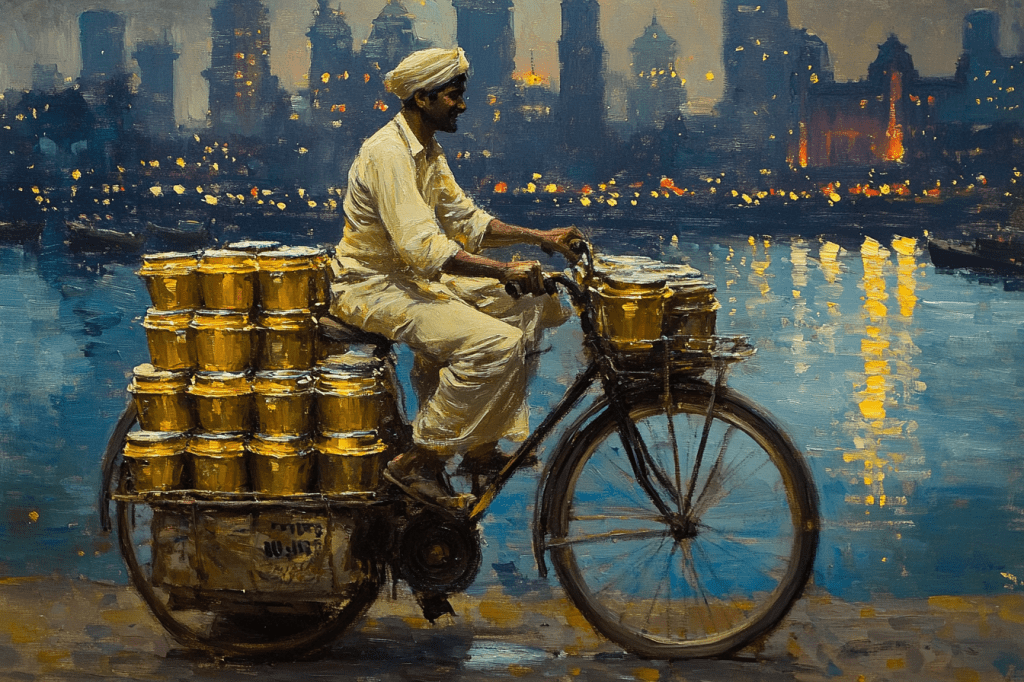
In a city where trains run like veins and the streets are an orchestra of honking chaos, a group of men quietly perform a daily miracle — they deliver over 200,000 homemade lunches across Mumbai with near-perfect precision. They don’t use GPS. They don’t have degrees in logistics. But they’ve been studied by Harvard Business School, applauded by Prince Charles, and even invited to TED Talks.
Meet Mumbai’s legendary Dabbawalas — the lunchbox warriors who turned a humble food delivery system into an unshakable legacy of discipline, trust, and jugaad.
📦 The Humble Beginning — One Lunchbox at a Time
The story begins in the 1890s, when a Parsi banker in colonial Bombay (now Mumbai) had a problem. He missed eating hot, home-cooked food during his workday. The canteens were terrible, restaurants were rare, and Uber Eats was a full century away. So he hired a man to bring him lunch from home.
That simple act sparked an idea. If one man needed it, surely many others did too. A man named Mahadeo Havaji Bachche spotted the opportunity and, along with a small team of men, started a lunchbox delivery service for office-goers.
It was a low-tech solution to a very relatable problem. And it worked. Really, really well.
🛵 From One Man to a Movement
By the early 20th century, the lunchbox system became a full-blown operation. It was tailor-made for Bombay — a city with:
- Long commutes
- Fixed work hours
- A strong “ghar ka khana” culture
- No modern food delivery infrastructure
Soon, thousands of men — mostly semi-literate workers from Maharashtra’s rural areas — were delivering lunchboxes (or dabbas) to white-collar workers in Mumbai’s downtown districts.
But here’s the kicker: these men weren’t just delivering food. They were building a logistical marvel that would eventually earn a Six Sigma rating for accuracy — a level of precision most global companies can only dream of.
🔤 Cracking the Dabba Code
Imagine delivering a hot lunch from someone’s home in the suburbs to their exact office desk on time, every single day — through trains, traffic, and weather — without the help of phones, maps, or tracking apps.
How do they do it?
With a genius color-coded system and old-school hustle.
Each lunchbox is marked with symbols that tell the dabbawala:
- Where the dabba came from (home location)
- Which train line to take
- Which station to get off at
- Which office it should end up in
The system is so refined that only one mistake happens in every 16 million deliveries. That’s less than one error a month. Amazon, are you listening?
The entire operation runs like a relay race:
- A dabbawala picks up the lunch from home in the morning.
- It gets sorted and grouped with other dabbas going to the same area.
- The batch is loaded onto a local train (Mumbai’s lifeline).
- Another dabbawala collects it at the destination station.
- It’s delivered to the customer — hot and on time.
🤝 More Than a Job — It’s a Brotherhood
The Dabbawalas aren’t your average delivery guys. They work as part of a cooperative trust called the Nutan Mumbai Tiffin Box Suppliers Association.
- Each member owns a share of the business.
- There are no bosses or managers.
- Everyone earns roughly the same — around ₹10,000 to ₹15,000 per month.
- They wear white Gandhi caps, carry ID cards, and operate on pure discipline.
And perhaps most importantly — they take pride in their work. There’s a sense of community, responsibility, and honor in every dabba delivered.
Missing a delivery isn’t just a failure — it’s a betrayal of trust.
📚 Harvard, Forbes & the Global Applause
In 2003, the world finally caught up to what Mumbai had known for over a century. Harvard Business School published a case study on the Dabbawalas, calling them “an outstanding example of supply chain excellence.”
They’ve since been featured by:
- BBC, Forbes, Time, and The Economist
- Invited to MIT and Stanford
- Met with Prince Charles, who was so impressed he invited them to his wedding
- Given a Six Sigma certification by Forbes — meaning 99.9999% accuracy
They’ve even delivered lunchboxes to Ratan Tata and Richard Branson!
All without spreadsheets, MBAs, or even smartphones.
📉 Challenges in the Modern World
Of course, even legends face struggles.
With more women working, and fast food becoming more accessible, some families have stopped cooking lunch at home. Competition from delivery apps like Swiggy and Zomato has also changed the game.
But the Dabbawalas aren’t giving up. Some have started embracing technology. A few have joined hands with NGOs and social causes. During the COVID-19 lockdown, many switched from lunchboxes to delivering essentials and medicines.
What keeps them going? The belief that home-cooked food is love — and love must be delivered.
💭 Why the Dabbawalas Matter Today
In an age of data, AI, and automation, the Dabbawalas remind us of something simple yet powerful:
✨ Human reliability, discipline, and community spirit can achieve the impossible.
They’ve shown that you don’t always need cutting-edge tech or Ivy League degrees to build a world-class operation. You just need commitment, coordination, and a deep sense of purpose.
So the next time you’re scrolling through your food delivery app, think about the quiet men in white caps, zigzagging through the city, making sure someone’s father, daughter, or spouse gets a warm, comforting taste of home — right on time.

 LoreShore
Leave a comment