
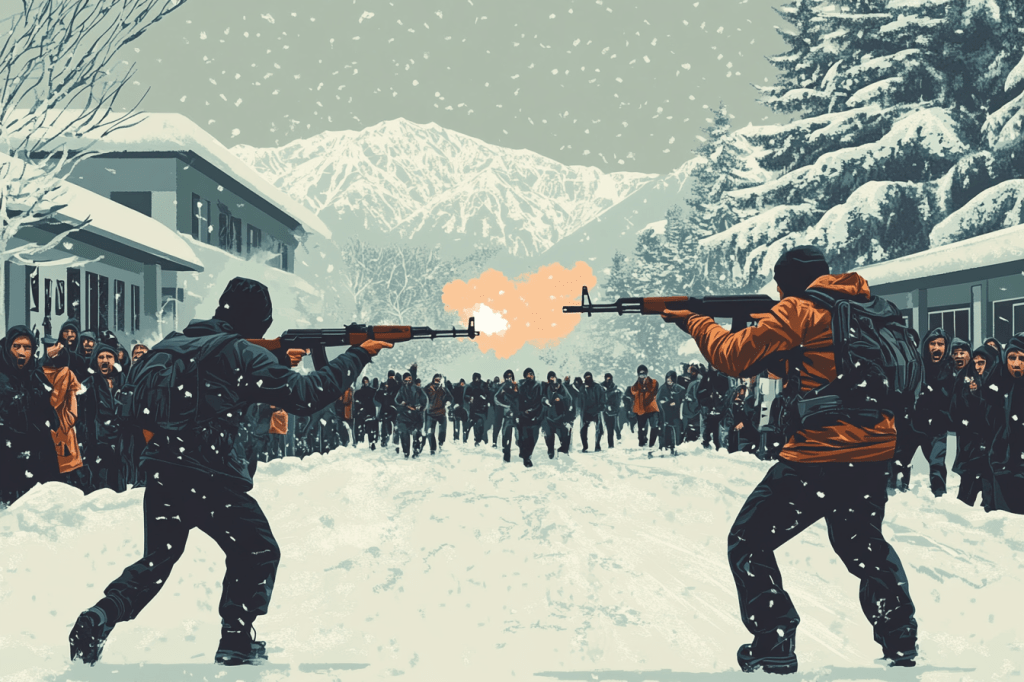
On the quiet evening of April 22, 2025, the serene valleys of Pahalgam in Jammu and Kashmir—once revered for their divine beauty—were desecrated by bloodshed. Gunmen affiliated with The Resistance Front, an offshoot of the Pakistan-backed Lashkar-e-Taiba, opened fire on a group of tourists. But this was no indiscriminate act of terror. Eyewitness reports reveal the attackers asked victims about their religion, sparing some and murdering others for not being Muslim. Twenty-eight innocent lives, including women and children, were extinguished in cold blood. Over 20 others were injured. This act of targeted hate is among the deadliest in recent memory, a chilling reminder of the poisonous grip of Islamic radicalisation in Kashmir.
The tragedy in Pahalgam is not just an isolated incident—it is the latest chapter in a decades-long saga of ideological warfare and religious extremism. To understand its roots, one must journey through Kashmir’s tortured history and the forces that have continuously derailed peace in the region.
From Autonomy to Extremism: The Rise of Radicalisation
After the partition of India in 1947, the princely state of Jammu and Kashmir acceded to India amidst a Pakistani-backed tribal invasion. What began as a territorial conflict soon evolved into a proxy war. By the late 1980s, following the rigging of the 1987 state elections, disillusioned youth turned away from democracy. Many crossed into Pakistan-occupied Kashmir, lured by promises of jihad and armed resistance.
What followed was a deliberate campaign by Pakistan’s intelligence agencies to transform a political grievance into a religious war. Radical Islamist ideologies were systematically introduced into the valley through training camps, propaganda, and imported terror groups. The movement that once demanded autonomy became hijacked by pan-Islamist goals, with slogans calling for the establishment of an Islamic caliphate. Local militancy morphed into foreign-sponsored jihad.
By the 1990s, Kashmir saw the horrifying exodus of Kashmiri Pandits, selectively targeted for their faith. It became evident: this was not just a separatist movement—it was religious cleansing. The recent Pahalgam attack is a cruel continuation of that same ideology.
The Human Toll: Victims of a Twisted Doctrine
The lives lost in Pahalgam were not just numbers—they were families on vacation, honeymooners, retirees on pilgrimage. According to survivors, the attackers first interrogated the tourists about their religion. Non-Muslims were executed in front of their loved ones. One witness recounted how her husband pleaded for mercy, only to be shot point-blank.
This chilling methodology is not new. Similar patterns were seen during the Wandhama massacre of 1998 and the Kaluchak attack in 2002. Each time, the target was clear: kill the non-Muslims, spread fear, divide communities.
The pain inflicted on the victims’ families is unimaginable. Children who watched their parents die, spouses torn apart, and communities reeling from grief. Their only crime? Their faith.
Yet amid the horror, the nation stood united. Hindu, Muslim, Sikh, and Christian leaders condemned the attack in one voice. In the valley too, there were tears for the dead. But justice must be more than a sentiment—it must be action.
The Cross-Border Hydra: Dealing with Pakistan
India’s battle for peace in Kashmir is not solely an internal one. For decades, Pakistan has nurtured, funded, and exported terror into the valley. Despite global pressure, terror camps still operate in Pakistan-occupied territories. The Resistance Front, Jaish-e-Mohammed, and Hizbul Mujahideen continue to thrive under state patronage.
While India has undertaken strong retaliatory actions in the past—such as the surgical strikes in 2016 and Balakot airstrikes in 2019—these need to evolve into a long-term, strategic doctrine. Diplomatic isolation, economic countermeasures, and targeted strikes on terror infrastructure must be continued and intensified.
At the same time, India must mobilize the global community. It is time the world sees Pakistan not as a victim of terror, but as its enabler. Clear and consistent pressure from allies, sanctions against identified sponsors, and holding Pakistan accountable at global forums like the UN and FATF are critical.
The Way Forward: Rooting Out the Ideology
To truly combat terror, India must strike not just at militants but at the ideology that sustains them. This means dismantling the networks of radicalisation—online and offline—that poison the minds of the youth. It requires a comprehensive counter-radicalisation policy that involves clerics, educators, and community leaders.
Local Muslims, who overwhelmingly reject violence, must be empowered to reclaim their faith from the clutches of extremism. Peace cannot be imposed; it must be built from within. The state must also continue investing in education, infrastructure, tourism, and economic opportunities—giving young Kashmiris reasons to dream beyond the gun.
Simultaneously, the victims and their families must not be forgotten. Compensation, psychological support, and memorialization of their loss are crucial. Their pain should not be in vain.
Conclusion: Choosing Justice Over Silence
The massacre at Pahalgam tears at the soul of a nation that has long borne the burden of terror with resilience. But this time, the brutality, the religious profiling, and the sheer inhumanity must not be met with routine condolences. It must spark resolve.
India stands at a crossroads—one path leads to strategic complacency, the other to determined action. Let us choose justice over silence, strength over appeasement, and peace over fear. Let us ensure that the memory of those murdered in Pahalgam becomes not a symbol of victimhood, but a catalyst for a future where no one dies for their religion.
Kashmir has bled enough. It is time to heal—not with half-measures, but with decisive will, enduring compassion, and unwavering unity.
 LoreShore
Leave a comment